

How Fixture Design Affects The Performance Of Automated Welding Machines And Systems
October 16, 2026
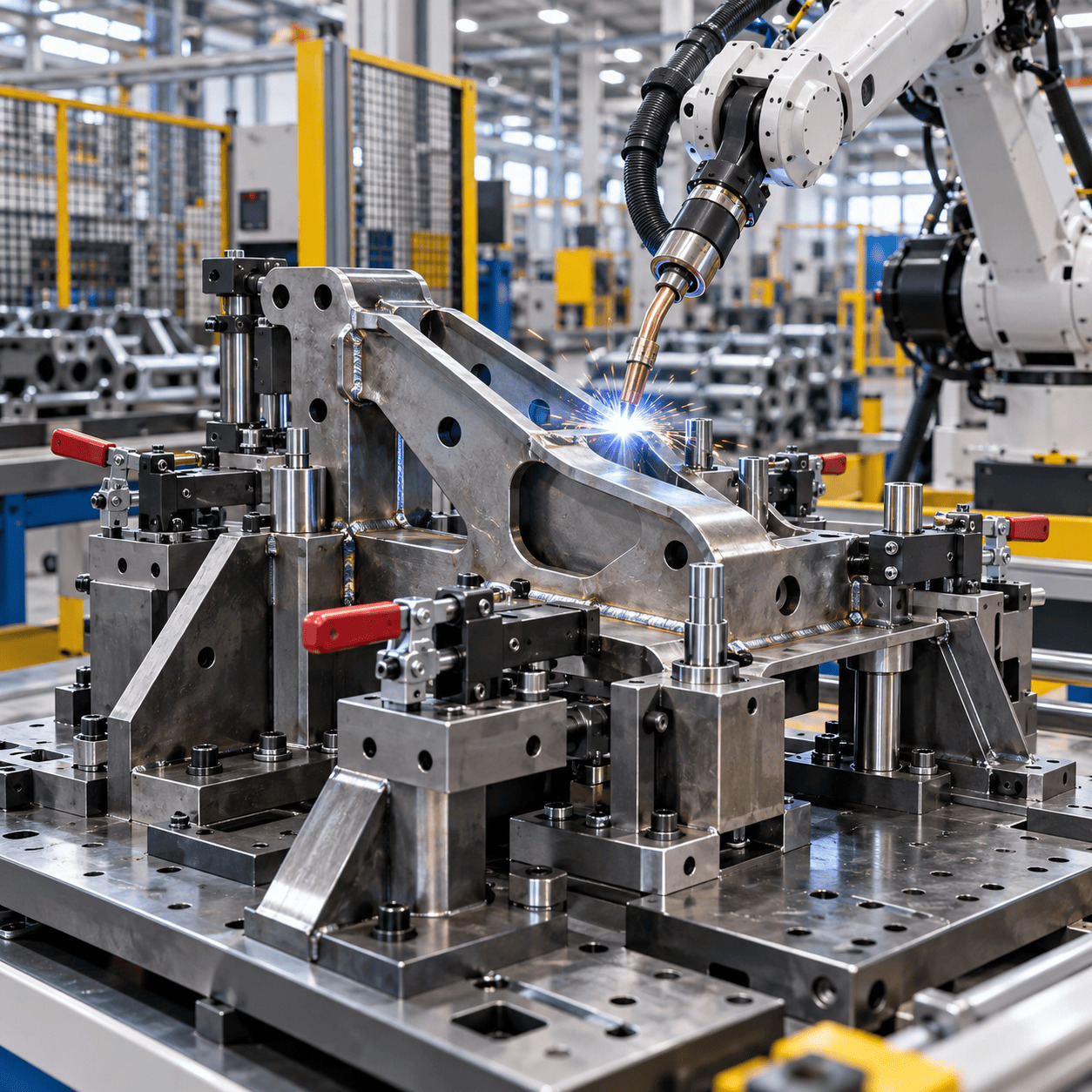
Fixture design is a key factor in determining weld accuracy, repeatability and process stability in automated welding systems. While the welding power source, robot programming and parameters control the welding process, the fixture determines how accurately the workpiece is positioned throughout production.
An unsuitable fixture can result in weld deviation, inconsistent joint alignment, excessive distortion, and increased cycle time. For manufacturers implementing welding automation, fixture design should be developed together with the welding process to achieve consistent production output.
Why Fixture Design Is Critical For Automated Welding Systems
Automated welding relies on fixed coordinates and repeatable workpiece positioning. Unlike manual welding, where an operator can adjust torch movement based on visual feedback, an automated system follows programmed paths based on the expected weld-joint location.
The fixture must therefore ensure that every component is placed in the same position for each welding cycle.
A properly designed fixture should provide:
- Accurate part location
- Sufficient clamping force
- Controlled movement during welding
- Consistent torch access
- Efficient loading and unloading
- Resistance against thermal distortion
The purpose of the fixture is not only to secure the workpiece, but also to maintain the relationship between the component and the programmed welding path.
1. Datum Positioning Determines Weld Accuracy
Accurate datum positioning is essential to maintain consistent weld location.
Fixtures should use defined locating points to control the position of the component before clamping. This prevents excessive movement and ensures that each workpiece references the same position during production.
Poor datum control can lead to:
- Welds missing the intended joint location
- Inconsistent penetration
- Uneven bead appearance
- Increased repair work
- Higher rejection rates
When integrating an automated welding machine, fixture accuracy should match the tolerance requirements of the component and welding application.
A programmed welding path cannot compensate for inconsistent workpiece positioning unless you add technologies such as seam tracking or adaptive control.
2. Clamping Design Affects Distortion Control
Clamping is required to maintain joint alignment during welding, but incorrect clamping methods can introduce additional problems.
During welding, heat input causes the material to expand and contract. If the fixture does not control movement correctly, the component may deform after cooling.
Fixture design should consider:
- Material type and thickness
- Weld sequence
- Heat input distribution
- Component geometry
- Clamp locations
- Required dimensional tolerances
For thin sheet metal, stainless steel components and large fabricated structures, distortion control becomes especially important.
The objective is to apply sufficient restraint to maintain positioning while avoiding excessive stress that may affect the final component dimensions.
3. Component Tolerance Affects Welding Repeatability
A fixture can only position a component accurately if the incoming parts are manufactured consistently.
For automated welding systems, variations in component dimensions can directly affect weld quality and process reliability.
Common sources of variation include:
- Cutting tolerance differences
- Inconsistent bending angles
- Uneven machining accuracy
- Variable joint gaps
- Misaligned assemblies
If components require manual adjustment before welding, the automation process may not achieve the expected repeatability.
Before implementing automation, manufacturers should evaluate upstream processes to ensure components can be consistently positioned within the required tolerance range.
4. Torch Accessibility Must Be Considered During Fixture Design
Fixture components must allow sufficient clearance for the welding torch and robot movement.
Restricted access can affect welding angle, travel direction and shielding gas coverage, which may reduce weld quality.
During fixture development, engineers should evaluate:
- Torch approach angle
- Robot wrist movement
- Cable routing
- Clamp interference
- Internal weld accessibility
- Multi-axis movement requirements
For complex components, fixture and robot simulation can help identify possible collision points before installation.
A well-designed fixture allows an automated welding machine to maintain the correct torch position throughout the welding cycle.
5. Fixture Design Influences Production Cycle Time
The productivity of an automated welding cell depends on the complete production cycle, not only welding speed.
Cycle time includes:
- Loading the component
- Locating the workpiece
- Clamping
- Welding operation
- Part repositioning
- Unclamping
- Component removal
A fixture that requires frequent manual adjustments can reduce the productivity gains expected from automation.
Manufacturers should consider:
- Quick clamping mechanisms
- Pneumatic or hydraulic systems
- Part loading guides
- Repeatable locating points
- Replaceable fixture components
Efficient fixture design reduces operator handling time and improves production consistency.
6. Validate Fixture Performance Before Production Implementation
Before commissioning automated welding systems, manufacturers should test the fixture using actual production components.
The validation process should evaluate:
- Workpiece positioning accuracy
- Clamp effectiveness
- Torch accessibility
- Weld quality
- Distortion levels
- Cycle time
- Operator handling requirements
Testing gives engineers the opportunity to identify potential issues before the system enters full production.
Engineers can then adjust fixture design, welding parameters, or component preparation before committing to larger investments.
Optimise Your Welding Automation Process With TSIS Welding Solutions
At TSIS Welding Solutions, we understand that welding automation performance depends on the complete production setup, including welding parameters, fixture design and component consistency.
Our team works with manufacturers to evaluate welding applications, conduct welding trials and determine suitable automation solutions based on actual production requirements. With our welding demonstration facilities and robotic welding capabilities in Klang, customers can assess their applications before implementing a system.
We do not simply supply equipment. We help manufacturers evaluate the technical requirements behind their welding process and develop solutions focused on repeatability, productivity and weld quality.
Planning to implement welding automation in your production line? Contact TSIS Welding Solutions to discuss your application and arrange a welding evaluation before selecting the right solution for your manufacturing process.