

When Do Robotic Welding Systems And Automation Make Financial Sense For A Malaysian Factory?
October 9, 2026
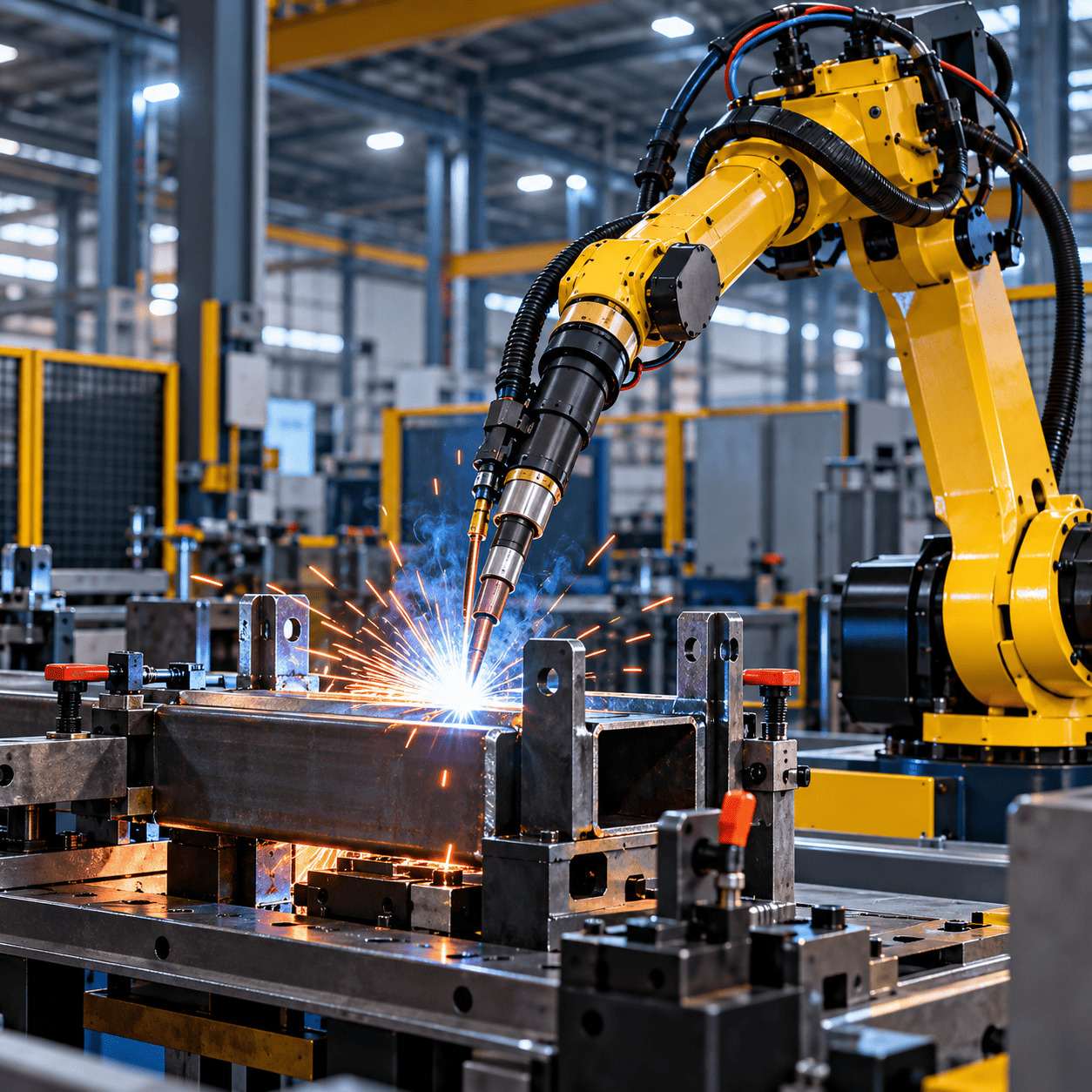
Automation can be a sizeable investment for any manufacturing operation. The question isn’t simply whether a factory can automate its welding process, but whether doing so will solve a costly production problem.
For Malaysian manufacturers facing rising output requirements, inconsistent weld quality, labour constraints or recurring rework, robotic welding automation may provide a practical way to improve production performance.
However, the financial case depends heavily on the application. Before committing to new equipment, manufacturers should look at where their current process loses time, labour, and money.
1. When Production Demand Starts Outgrowing Welding Capacity
One of the clearest signs that automation may be worth considering is when welding becomes a production bottleneck.
Manual welding remains suitable for many applications, especially where production volumes are relatively low, or components change frequently. Problems can arise when the same parts need to be welded repeatedly at increasing volumes.
Typical warning signs include:
- Frequent overtime to meet production schedules
- Orders being delayed at the welding stage
- Welders struggling to keep up with upstream production
- Repetitive components occupying large amounts of welding time
- Plans to increase production without significantly increasing headcount
An automated process can perform repetitive welding tasks according to programmed parameters and cycle times, allowing manufacturers to increase capacity for suitable applications.
The key point is that automation should address an identifiable constraint rather than being introduced simply because the technology is available.
2. When Rework And Weld Inconsistency Are Increasing Costs
Inconsistent welding can create expenses far beyond the original welding operation.
Variation between components may lead to additional grinding, repair work, inspection, rejected parts and production delays. At high production volumes, even small amounts of rework can become expensive.
Well-designed robotic welding systems can improve repeatability because the welding path and process parameters can be controlled consistently from one cycle to the next.
Before considering an investment, manufacturers should calculate how much they currently spend on:
- Weld repairs
- Rejected components
- Scrap materials
- Grinding and finishing
- Additional inspections
- Production delays related to welding defects
These figures can help determine whether improved process consistency would generate a meaningful financial return.
3. When Skilled Labour Becomes A Production Constraint
Experienced welders remain essential to manufacturing, particularly for complicated joints, changing applications and troubleshooting.
However, using highly skilled personnel for repetitive welding throughout an entire shift may not always be the most effective use of that expertise.
Automation can allow experienced employees to focus on areas such as:
- Complex or low-volume welding
- Process setup
- Quality inspection
- Troubleshooting
- Programming and parameter optimisation
- Production improvement
This becomes particularly relevant when a manufacturer regularly relies on overtime or struggles to recruit enough experienced welders to support increasing production.
The financial calculation should therefore consider more than labour replacement. It should also consider productivity, overtime, training, production capacity, and how existing employees could be deployed more effectively.
4. Is Your Application Suitable For Automation?
Not every welding process should be automated.
Successful automation depends heavily on how consistent the surrounding production process is. If parts regularly arrive with large dimensional variations or poor joint fit-up, an automated system may struggle to achieve consistent results.
Before proceeding, manufacturers should evaluate:
- Part repeatability
- Joint design and accessibility
- Fixture accuracy
- Material type and thickness
- Welding position
- Component variation
- Production volume
- Required cycle time
Good fixtures are particularly important because the equipment expects the weld joint to appear in a predictable location.
For this reason, manufacturers should evaluate the entire production process rather than treating automation as a standalone equipment purchase.
5. Look Beyond The Initial Cost Of A Robotic Welding Machine
Purchase price matters, but it doesn’t tell the whole story.
A robotic welding machine should be evaluated against the cost of continuing with the existing process.
Manufacturers can start by calculating current annual costs associated with:
Labour + overtime + rework + scrap + downtime + production losses
These can then be compared against potential automation costs such as:
Equipment + integration + fixtures + training + maintenance + operating expenses
The expected improvements in throughput and process consistency should also be considered.
Rather than asking only, “How much does automation cost?”, management teams can ask:
“What is our current welding problem costing us every year?”
This shifts the discussion from equipment price to potential business value.
6. Why Testing Before Investing Matters
Specifications alone cannot tell manufacturers how well an automated process will perform on their actual components.
A welding trial can provide much more useful information.
Representative workpieces can be used to evaluate factors such as welding parameters, joint accessibility, fit-up, fixtures and process suitability before a larger investment is made.
Testing may also uncover production issues that need to be corrected first. For example, inconsistent component dimensions might need to be addressed before automation can deliver the expected repeatability.
This makes application testing an important part of reducing investment risk.
Is Your Factory Ready For Robotic Welding Systems?
A factory doesn’t necessarily need to automate every welding station to gain value from automation.
Often, the best starting point is one repetitive process where production volume, rework, capacity or labour requirements are already creating measurable costs.
From there, manufacturers can evaluate whether robotic welding systems would improve the economics of that specific application.
The goal should not be automation for its own sake. It should be a measurable improvement in the manufacturing process.
Discuss Your Welding Needs With TSIS Welding Solutions
At TSIS Welding Solutions, we believe manufacturers should understand how a solution performs for their actual application before making a major investment.
Our team can help you assess your welding requirements, explore suitable equipment and determine where robotic welding automation may fit into your production process. With our welding demonstration facilities and robotic cells in Klang, you can discuss your application and explore testing before deciding on the right approach.
We don’t simply want to supply you with a robotic welding machine. Our focus is helping you identify a solution that makes technical and commercial sense, supported by welding expertise, application testing and technical assistance.
If you’re planning welding automation for your factory, contact TSIS Welding Solutions to discuss your application and arrange a welding demonstration or test.